How Video Editing Turns a Normal Business Into a Premium Brand in Saudi Arabia & GCC
June 10, 2026
Read More
Discover 12 Social Media Marketing in Saudi Arabia trends shaping brand growth in 2026, from AI and short-form video to social commerce and paid media.
Saudi consumers are not simply spending more time online. They are discovering brands, comparing products, watching reviews, messaging businesses, following creators, and making purchase decisions without leaving their favorite platforms.
That shift makes Social Media Marketing in Saudi Arabia far more than a visibility channel in 2026. For ambitious brands, it has become part of the customer-acquisition engine, the shopping journey, the service experience, and increasingly, the revenue model itself.
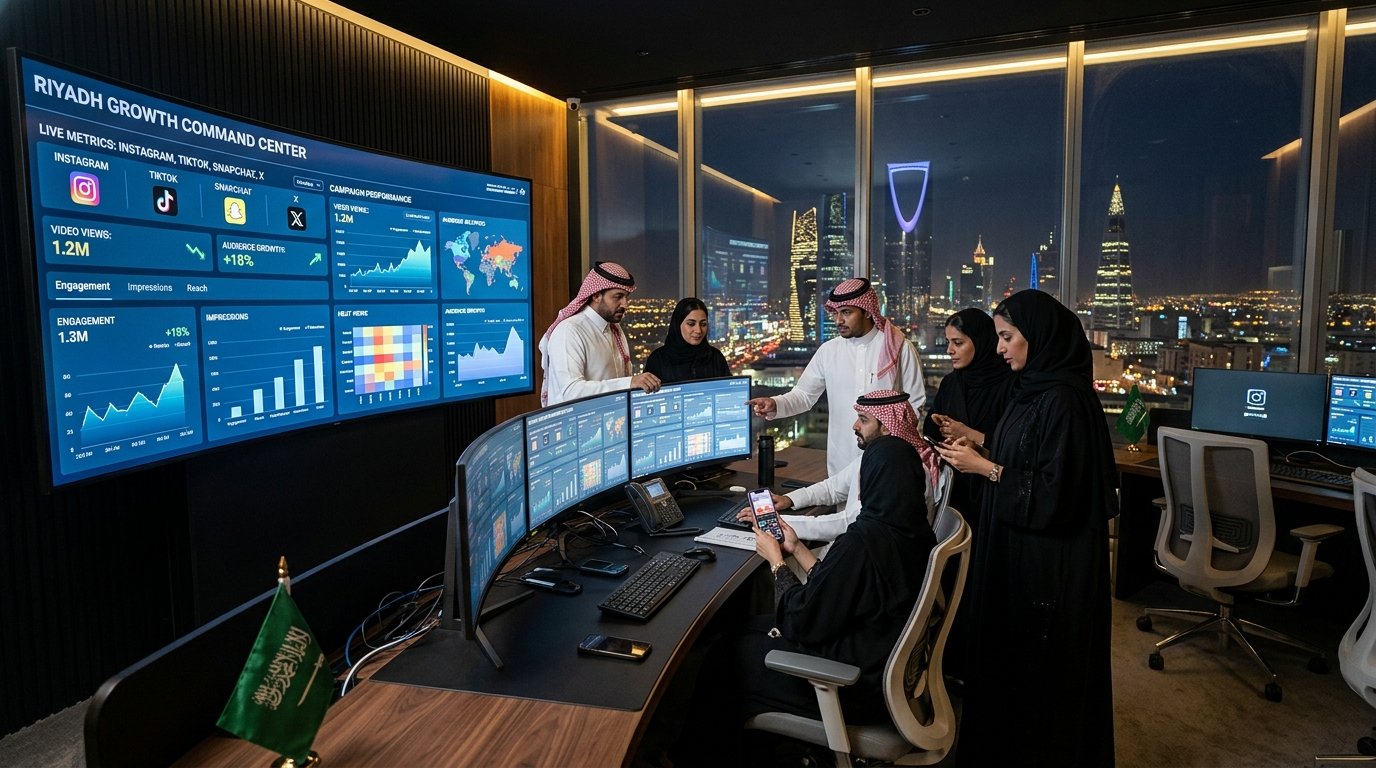
Saudi Arabia entered 2026 with one of the world's most connected consumer markets. DataReportal reported 34.4 million internet users at the end of 2025, representing 99% internet penetration. Its data also recorded 38.6 million social media user identities, although the report cautions that these figures can include duplicate identities and should not be interpreted as unique individuals.
The opportunity is enormous, but competition for attention is becoming equally intense.
Brands that still treat Instagram, TikTok, Snapchat, LinkedIn, X, and YouTube as simple publishing channels will struggle against competitors building culturally relevant, data-driven and conversion-focused social ecosystems.
Here are the 12 trends defining how brands can compete and grow in Saudi Arabia in 2026.
Artificial intelligence is no longer valuable simply because it can produce captions faster. As demonstrated in AI video editing for GCC brands in 2026 and practical AI tools for Saudi SMEs, automated intelligence now powers predictive creative workflows.
The bigger opportunity in 2026 is using AI to understand audiences, recognize creative patterns, predict campaign performance and identify opportunities before marketing budgets are wasted.
A sophisticated Saudi brand can analyze hundreds of posts, comments, campaign variations and audience signals to understand which hooks create attention, which offers drive action, what subjects increase engagement and where potential buyers lose interest.
That intelligence changes social marketing from reactive publishing into continuous optimization.
Businesses investing in social media marketing services in Saudi Arabia should therefore look beyond agencies that simply schedule posts. The stronger commercial advantage comes from combining local market knowledge, creative judgment, analytics and AI-assisted decision-making.
Saudi audiences quickly notice generic content.
Automated captions that technically use Arabic but ignore Saudi expressions, cultural expectations, purchasing behavior or local context can weaken trust instead of improving efficiency.
Research published in 2026 on Saudi influencer marketing similarly highlights the importance of cultural alignment and authenticity, noting that excessive automation can create tension with the human credibility audiences expect.
Winning brands will use AI behind the scenes while keeping human cultural intelligence visible at the front.
Translating an English campaign into Arabic after the concept has already been approved is becoming an outdated approach. High-performing brands now integrate Arabic-first video editing for Saudi audiences from the very start.
Arabic-first marketing starts earlier.
The message, visual hierarchy, humor, tone, typography, pacing and call to action should be developed with the Saudi audience in mind from the beginning.
That matters because localization affects more than language. A luxury consumer in Riyadh, a university student in Jeddah and a B2B decision-maker in Dammam may respond to very different creative cues despite living inside the same national market.
Successful Saudi social media marketing therefore requires brands to understand audience context before designing the campaign.
Companies should invest in creative design for social media campaigns that feels native to the platform and recognizable to local consumers rather than recycling global assets with translated text placed over them.
The goal is not to make every advertisement look traditionally Saudi.
The goal is to understand what feels credible.
Brands that get this right can make products feel closer, offers feel more relevant and marketing feel less like advertising.
Short-form video is now one of the most valuable discovery formats, and mastering how video editing turns a normal business into a premium brand in the GCC is what converts casual viewers into premium customers.
A potential customer may discover a restaurant through a TikTok recommendation, a fashion label through an Instagram Reel, a property through Snapchat, or a technology company through a short educational video.
That makes the opening seconds commercially critical.
Brands need stronger hooks, immediate context, recognizable problems, authentic demonstrations and faster storytelling.
Professional video editing services for Saudi brands can play an important role here because successful short-form creative depends on more than cutting footage together. Rhythm, subtitles, Arabic text placement, mobile framing, transitions, sound design and platform-native pacing can determine whether a viewer keeps watching or scrolls away.
Google's advertising resources indicated that YouTube could reach about 27.5 million people in Saudi Arabia in late 2025, equivalent to roughly 80% of the country's internet user base.
TikTok's reported advertising audience also expanded significantly through 2025, although DataReportal warns that its advertising figures can exceed population counts and should not be interpreted as unique active users.
Product demonstrations, comparisons, customer problems, transformations, founder-led insights, tutorials, behind-the-scenes footage and culturally relevant entertainment can all create demand when the content gives viewers a reason to continue watching.
Targeting technology continues to improve, but better targeting cannot rescue weak advertising.
In 2026, creative quality increasingly determines how efficiently businesses can acquire customers.
Strong advertisers are testing different opening hooks, visual angles, offers, formats, calls to action and audience problems rather than depending on one polished campaign for an entire quarter.
Saudi Arabia's digital advertising market is expanding rapidly. One 2026 market estimate projected digital ad spending in the country to reach approximately $4.68 billion during the year.
As more businesses compete for the same audience, inefficient creative becomes expensive.
Companies investing in paid advertising in Saudi Arabia should judge campaigns by business outcomes rather than impressions alone.
A serious campaign connects creative production with audience segmentation, retargeting, landing pages and conversion measurement.
Engagement can reveal useful signals, but qualified leads, purchases, customer-acquisition cost and return on advertising spend should influence where the next riyal goes.
One campaign should not automatically become five identical posts.
Every major platform creates a different user mindset.
Instagram works well for visual discovery, lifestyle positioning, Reels and product storytelling. TikTok rewards fast-moving discovery and personality. Snapchat remains exceptionally important in Saudi Arabia for direct, frequent and informal communication.
Snapchat's advertising resources reported 25.3 million users in Saudi Arabia in late 2025, with its potential ad reach equivalent to 73.6% of the country's internet user base.
LinkedIn serves a different purpose. It provides a powerful environment for B2B authority, recruitment, professional services, technology and executive positioning. LinkedIn's advertising tools reported 12 million registered members in the Kingdom at the end of 2025, although registered-member figures are not directly comparable with active-user measurements on other platforms.
This fragmentation is also changing discovery. Consumers increasingly search TikTok, Instagram, YouTube and other networks for recommendations.
Brands can strengthen that discovery ecosystem by combining social visibility with SEO services in Saudi Arabia, helping valuable content appear across both search engines and social discovery journeys.
The distance between “I like this” and “I want to buy this” keeps shrinking, making it crucial for social merchants to understand how to build trust in a Saudi e-commerce store.
That is one of the most important developments in Saudi digital commerce.
A user may discover a product in a creator video, watch another demonstration, open the brand profile, message the business and make a purchase without following the traditional search-engine-to-homepage journey.
This makes social commerce especially attractive for fashion, cosmetics, food, lifestyle products, electronics, home goods and other visually demonstrable categories.
Saudi businesses using Shopify development for Saudi businesses can connect social discovery with structured product pages, inventory, payment experiences and conversion-focused storefronts.
Every unnecessary step gives the buyer another opportunity to abandon the transaction.
Fast mobile pages, clear prices, trusted payment options, straightforward delivery information and strong product imagery help move social traffic closer to checkout.
Saudi social-commerce analysis published in 2026 also points to Instagram, TikTok and Snapchat as important product-discovery environments, with local brands increasingly using social platforms as storefronts rather than awareness channels alone.
The winning metric is not how many people watched the product.
It is how effectively the experience transforms qualified attention into revenue.
The biggest influencer is not always the most profitable influencer.
Brands are becoming more selective about creator partnerships because follower count does not automatically produce purchasing intent.
A smaller Saudi creator with strong audience trust inside a specific category may generate better commercial results than a celebrity with a huge but less relevant following.
That shift is making niche creators particularly valuable in food, travel, technology, beauty, fitness, gaming, automotive, fashion and professional services.
Influencer activity should also connect with the wider purchasing infrastructure. Brands investing in e-commerce development in Saudi Arabia can create dedicated landing experiences, creator-specific offers, tracked links and conversion paths that reveal which partnerships actually sell.
Saudi influencer research emphasizes cultural fit, perceived authenticity and credibility as important factors shaping consumer responses.
A creator should therefore feel naturally connected to the product.
Over-scripted endorsements often look like advertising immediately. Strong collaborations give creators enough structure to communicate the selling point while preserving the voice audiences already trust.
The phrase ai-powered social media management agency riyadh increasingly describes more than an agency using generative tools.
The stronger model involves AI-assisted operations across research, content analysis, audience segmentation, campaign reporting, social listening and performance forecasting.
Instead of waiting until the end of the month to discover that a campaign failed, marketers can spot declining engagement, creative fatigue or weak conversion signals earlier.
That creates faster decision cycles.
AI can also help identify which audiences require additional nurturing before a sale. Companies can then use email marketing services in Saudi Arabia to continue the relationship outside the social feed with relevant offers, educational content, product reminders or abandoned-cart communication.
The strongest system does not treat a follower as the final result.
It moves people from awareness to consideration, from consideration to first-party contact and from first purchase toward repeat business.
The objective is simple: improve timing without making communication feel mechanical.
Consumers increasingly use social platforms like search engines.
They search for restaurants, reviews, destinations, tutorials, products, software recommendations, clinics, fashion inspiration and service providers directly inside social apps.
This changes how brands should create content.
A clever caption with no searchable context may lose visibility to a straightforward post that clearly explains what the business offers, where it operates and what problem it solves.
That is why social media growth strategies Saudi Arabia increasingly include keyword-aware captions, spoken keywords in video, descriptive on-screen text, location context and useful educational content.
Businesses should also make sure discovery does not collapse after someone clicks through. Professional web development services in Saudi Arabia can create faster, clearer and more persuasive destinations for users arriving from high-intent social searches.
Instead of repeatedly posting “Choose us,” answer the questions customers ask before choosing anyone.
Explain price considerations. Compare options. Demonstrate the process. Show common mistakes. Address objections. Reveal what buyers should look for.
Helpful content earns discovery because it matches intent.
A successful social campaign should not end when somebody clicks.
The user may need to visit a landing page, compare an offer, read reviews, request information, message the company, receive a follow-up and return through retargeting before converting.
That means the role of a modern social media marketing agency Saudi Arabia is increasingly connected to the complete customer journey.
The marketing team needs to know what happens after traffic leaves the platform.
If hundreds of interested users click an advertisement but the destination loads slowly, hides pricing, feels untrustworthy or creates unnecessary form friction, social performance will look weaker than it actually is.
Brands should examine the complete acquisition path from impression to revenue.
Social content creates desire. Advertising accelerates reach. The website explains. Sales follow-up removes uncertainty. Retargeting recaptures interest. Customer experience influences repeat purchases.
When those pieces reinforce each other, marketing becomes easier to scale.
Public engagement tells only part of the story.
Many serious buying conversations happen privately.
A customer may watch a Reel without liking it, visit a profile twice, send the product to a friend and eventually contact the company through direct message or WhatsApp.
Brands that evaluate content only by visible comments can miss this hidden intent.
In 2026, social teams need stronger systems for turning private inquiries into sales.
That requires fast response times, clear product knowledge, Arabic communication, lead qualification and smooth handoffs between marketing and sales.
A high-performing advertisement can still waste money when unanswered messages sit for hours.
Customers expect clarity.
They want to know whether an item is available, how much it costs, when it will arrive, whether the business serves their city and what happens after purchase.
Brands that answer those questions quickly remove buying resistance while the customer's interest is still active.
Social platforms provide useful analytics, but brands should not allow their entire understanding of customers to live inside rented platforms.
In 2026, stronger marketers are building first-party data through customer accounts, inquiries, CRM systems, purchases, subscriptions and consent-based communication.
The objective is better attribution.
Businesses need to understand which campaign introduced the customer, what content influenced consideration, which offer triggered conversion and whether that customer eventually purchased again.
It is, “What did social contribute to pipeline, transactions and customer lifetime value?”
That shift encourages better investment decisions.
A campaign generating fewer leads may deserve more budget if those leads close at a significantly higher rate.
Similarly, an educational video may generate little immediate revenue but influence dozens of future customers.
The brands that connect those signals will allocate money more intelligently than competitors chasing surface-level engagement.
The Saudi digital market is moving toward integration.
AI is improving marketing intelligence. Short video is shaping discovery. Social commerce is reducing buying friction. Creators are becoming performance partners. Search behavior is moving inside platforms. Private conversations are becoming sales channels.
At the same time, Saudi Arabia's broader digital transformation continues to create favorable conditions for technology-led business growth. Vision 2030's 2025 annual reporting highlighted continued investment in digital infrastructure, artificial intelligence, innovation and the knowledge economy.
For businesses, this means the opportunity is larger—but so is the standard required to compete.
Generic posting will not build meaningful market share.
Brands need culturally relevant creative, disciplined testing, strong offers, connected customer journeys and measurement systems that reveal what actually generates revenue.
Start with the customer rather than the content calendar.
Understand what your audience wants to achieve, what frustrates them, what they compare before purchasing and what prevents them from trusting a new brand.
Then choose platforms based on behavior rather than popularity.
A B2B technology company may prioritize LinkedIn and YouTube, while a fashion retailer may place more emphasis on TikTok, Snapchat and Instagram.
The content mix should also follow commercial intent.
Use discovery content to attract unfamiliar audiences. Use educational content to establish credibility. Use proof to reduce uncertainty. Use demonstrations to strengthen desire. Use offers when the customer is ready to act.
Finally, connect measurement to business results.
Track traffic quality, inquiries, conversion rates, customer-acquisition costs, revenue and repeat purchasing alongside reach and engagement.
That approach transforms social media from a publishing obligation into an accountable growth channel.
Social Media Marketing in Saudi Arabia is entering a more demanding stage. Audiences have more choices, platforms are more competitive and businesses are investing more aggressively in digital acquisition. Simply being active is no longer enough.
The opportunity belongs to brands that combine Saudi market understanding with strong creative, intelligent advertising, short-form storytelling, social commerce, first-party data and measurable conversion journeys. Businesses ready to turn those capabilities into sustainable growth can work with Codhaus to build a more connected digital presence designed not merely to attract attention, but to convert that attention into qualified demand, customers and long-term revenue.
The biggest overall shift is the movement from isolated social publishing toward integrated, AI-assisted customer-acquisition systems. Brands are increasingly connecting content, advertising, creators, social commerce, analytics, CRM data and sales follow-up rather than measuring each channel independently. AI accelerates this transformation by helping marketers analyze performance and make faster decisions, but local cultural judgment remains essential.
There is no single platform every company should prioritize. Snapchat has exceptionally strong reach in Saudi Arabia, while TikTok has become a major discovery environment. Instagram remains powerful for visual products and lifestyle brands, and YouTube provides substantial video reach. LinkedIn can be especially valuable for B2B companies, recruitment and executive thought leadership. The best platform mix depends on customer demographics, purchasing intent and the type of content a brand can consistently produce.
For many consumer and local service categories, high-quality Arabic communication can significantly improve relevance. However, simply translating English content is not enough. The message should account for cultural expectations, terminology, tone, typography and the way Saudi audiences naturally communicate online. Some B2B and expatriate-focused campaigns may successfully use English, so language strategy should follow the audience.
Yes, but brands are becoming more performance-focused. Relevant creators with trusted communities can be more valuable than personalities chosen solely because they have large follower counts. The strongest partnerships connect creator credibility with trackable landing pages, offers, promo codes or other conversion mechanisms.
Reduce the distance between discovery and action. Show products clearly, explain benefits quickly, answer objections, make mobile purchasing simple and respond to inquiries while customer interest is high. Retarget people who engaged without converting and continuously test new creative angles rather than depending on one advertisement.
It is extremely important for discovery, particularly on TikTok, Instagram, Snapchat and YouTube's short-form ecosystem. The strongest videos communicate value quickly and feel native to the platform. High production quality can help, but usefulness, authenticity and relevance often matter more than cinematic polish.
AI can accelerate research, ideation, variations, analysis and operational workflows. It should not replace strategic thinking or local cultural understanding. Businesses that publish large quantities of generic AI-generated material risk losing the trust and distinctiveness required to build a memorable Saudi brand.
Start with the commercial objective. For e-commerce, track attributed revenue, conversion rate, average order value, repeat purchases and customer-acquisition cost. For lead-generation businesses, monitor qualified leads, cost per qualified lead, meetings, proposals and closed revenue. Reach and engagement remain useful diagnostic metrics, but they should support commercial measurement rather than replace it.

June 10, 2026
Read More
June 14, 2026
Read More
June 12, 2026
Read More
June 16, 2026
Read More
May 24, 2026
Read More