A website can look impressive and still fail to generate enquiries, support customers, or justify its development cost. Successful website design and development starts with understanding what the business needs to achieve, not choosing colours or templates. For companies in Saudi Arabia, that also means considering Arabic-language experiences, technical performance, security, and local business requirements. This guide explains how to plan, design, develop, test, and launch a professional website, including the decisions, deliverables, and costs business owners should understand before committing to a project.
Why Website Design and Development Matters for Saudi Businesses
A business website is often where customers assess your credibility before making contact. Whether you're operating a consultancy in Riyadh, a trading company in Jeddah, or a service business across the Kingdom, your website should help visitors find information and take meaningful action.
The difficulty usually begins when development starts without agreed requirements. Features change, content arrives late, and stakeholders disagree about what the finished website should do.
A structured approach connects your commercial objectives with user experience, development decisions, measurable results, and long-term ownership.
Website Design and Development in Saudi Arabia: Start With the Right Business Goals
Before commissioning a website, establish what customers should accomplish and what those actions mean for your business. The Saudi demand for custom web development is worth considering alongside the wider digital transformation associated with Vision 2030, but the right investment still depends on each company's actual requirements.
Identify the Purpose of Your Business Website
A website's primary objective determines its functionality and content. A law firm may prioritise consultation requests, while a wholesale supplier might need product enquiries and account-based purchasing.
Define one principal conversion, such as a qualified lead, confirmed booking, or completed order. Then identify supporting actions such as downloading a brochure, calling your office, or viewing a service page.
Measure outcomes rather than visits alone. Ten relevant enquiries may be more valuable than thousands of visitors who never become customers.
Choose the Right Type of Website for Your Business
Different business models require different website structures. Choosing a platform before defining the business use case can create unnecessary development work.
| Website Type | Main Business Objective | Essential Features |
|---|---|---|
| Corporate website | Establish credibility | Services, company information, enquiries |
| Landing page | Generate campaign leads | Focused offer, conversion form |
| E-commerce store | Sell products online | Catalogue, checkout, order management |
| Customer portal | Support existing customers | Login, records, account access |
| Custom web application | Run business workflows | Dashboards, integrations, automation |
For example, a B2B distributor may need wholesale pricing visible only to approved buyers. A conventional company website would not provide that functionality without additional development.
Website Development vs Website Design: What's the Difference?
Understanding website development vs website design prevents confusion about responsibilities and project deliverables. Design determines how people interact with the interface, while development makes those interactions work.
Knowing when professional website development adds value is particularly useful when comparing a simple website builder with a project involving integrations, custom functionality, or long-term technical responsibilities.
What Does Website Design Include?
Website design covers information architecture, navigation, page layouts, typography, branding, and user experience. Designers may use Figma to create website wireframes and interactive prototypes before engineering begins.
The deliverables can include mobile and desktop mockups, reusable design components, and interaction specifications.
A design approval confirms that the proposed experience meets expectations. It does not establish that forms, databases, payments, or integrations actually function.
What Does Website Development Include?
Development converts approved designs into working pages and systems using technologies such as HTML, CSS, JavaScript, databases, and application programming interfaces (APIs).
Frontend development handles the visible interface. Backend development manages business logic, authentication, and data processing where necessary.
A basic information website may not require a custom database, whereas a customer portal generally needs secure account management and server-side functionality.
How to Prepare a Website Development Brief Before Starting Your Project
A website project brief describes what must be delivered, who will use it, and how success will be assessed.
When evaluating custom web development in Saudi Arabia, a detailed brief helps distinguish genuinely necessary features from expensive additions that contribute little business value.
Define Your Business Objectives and Target Audience
Begin website requirements gathering by identifying your customers, their problems, and the actions they should complete.
Consider whether your audience includes Saudi consumers, procurement departments, corporate decision-makers, or international clients.
A B2B engineering company, for example, may need detailed capabilities, certifications, project information, and quotation forms rather than a simplified shopping experience.
Specify the intended geographic reach and choose measurable objectives before content production starts.
Document Your Website Requirements and Essential Features
Translate your objectives into functional requirements.
Document the page inventory, contact forms, content management system (CMS), customer accounts, analytics, and required integrations. Separate launch-critical features from enhancements that can follow later.
For example, a quotation form might need to validate customer information, create a CRM record, and notify the sales department.
Also capture less visible requirements such as form security, permissions, error messages, accessibility, and data handling. These affect implementation even when customers never see them directly.
Set the Project Scope, Budget, Timeline, and Responsibilities
The website project scope should define deliverables, exclusions, revision rounds, approval stages, and ownership arrangements.
Your website project timeline must account for client responsibilities as well as development work.
| Project Requirement | What to Agree Before Development |
|---|---|
| Content | Who provides copy, translations, and images? |
| Functionality | Which features are included at launch? |
| Approvals | Who signs off on designs and testing? |
| Ownership | Who controls the domain, code, and hosting? |
| Changes | How will additional requests be priced? |
Documenting these decisions limits misunderstandings and provides a reference if requirements change.
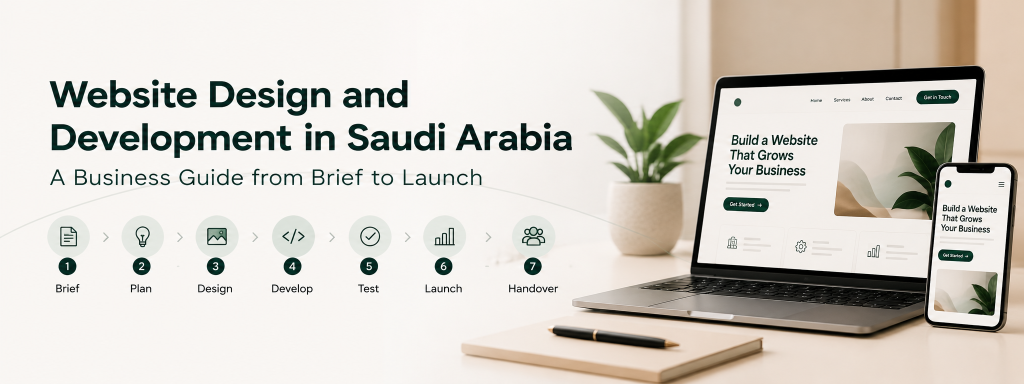
Website Development Process: 7 Essential Stages From Brief to Launch
The website development process connects discovery, planning, design, implementation, content, testing, and deployment.
Although projects vary in complexity, each phase should produce a reviewable deliverable. Project managers coordinate dependencies while business owners validate whether the work meets the approved requirements.
Understanding the Website Development Life Cycle
The website development life cycle describes how a project progresses from requirements to release and ongoing improvement.
Some teams use sequential delivery, while others work iteratively through short development cycles. Neither approach removes the need for clear acceptance criteria.
The important distinction is between completing technical tasks and delivering functionality the business has accepted. Design revisions, content preparation, and testing may overlap rather than occur in isolation.
The 7 Stages of Website Development
Understanding the stages of website development helps businesses identify when decisions and approvals are required.
| Stage | Core Activity | Main Deliverable |
|---|---|---|
| 1. Discovery & Brief | Gather business requirements | Approved project brief |
| 2. Planning & Sitemap | Organise pages and functionality | Sitemap and specifications |
| 3. Wireframes & UI/UX | Design user interactions | Approved interface |
| 4. Development & CMS | Implement functionality | Working staging website |
| 5. Content & SEO | Prepare pages for users and search | Reviewed content and metadata |
| 6. Testing & QA | Identify and correct defects | Test results and issue register |
| 7. Approval, Deployment & Launch | Release the approved build | Live production website |
These phases of website development represent delivery milestones, not completely isolated activities. Content writers can prepare copy while developers build approved layouts, and quality checks should begin before the final testing stage.
A staging environment allows stakeholders to review the working website without exposing unfinished functionality to customers.
Website Development Steps and Approval Milestones
The most important website development steps include formal decisions about requirements, design, functionality, and launch readiness.
The client should approve the brief before significant implementation begins and review the interface before extensive frontend development.
Final approval should follow user acceptance testing rather than visual inspection alone.
Record unresolved defects, requested revisions, and authorised sign-offs. Informal approval messages can become problematic when project requirements are later disputed.
UI/UX Website Design: Creating a Responsive, User-Friendly Experience
Effective UI/UX website design makes information easy to discover and actions straightforward to complete.
The interface should work across devices, accommodate different user needs, and reinforce the business objective without overwhelming visitors.
Plan Website Navigation, Wireframes, and User Journeys
Website wireframes help teams establish layouts before investing in detailed visual design.
Map the journey from landing page to conversion. A visitor seeking accounting services, for example, should be able to review relevant capabilities, understand the engagement process, and request a consultation.
Use descriptive navigation labels, logical page hierarchy, contextual links, and clear contact routes.
Avoid dead-end pages or menus that require customers to understand your internal company structure.
Design for Mobile Devices and Accessibility
Responsive web design adapts interfaces to different screens, while mobile-first website development considers smaller screens and touch interactions from the beginning.
Readable typography, appropriately sized controls, clear form labels, keyboard navigation, and meaningful error messages all improve usability.
Accessibility should also be assessed against relevant WCAG criteria.
For complex interfaces, React development in Saudi Arabia can support reusable responsive components, provided the implementation follows sound accessibility and performance practices.
Design Landing Pages Around Conversions
A landing page should answer three questions quickly: What is being offered? Why should the visitor trust the business? What happens next?
Combine a clear value proposition with specific service information, genuine evidence, and one prominent call to action.
For Saudi service businesses, contact methods may include forms, telephone enquiries, or WhatsApp.
Keep forms proportionate to the information genuinely required. Every unnecessary field creates additional friction.
Professional Website Development: Choosing the Right CMS and Technology
Professional website development requires a technology decision that reflects functionality, internal skills, content management, integrations, and maintenance.
A platform that fits a small corporate website may not suit a complex procurement portal. Likewise, expensive custom engineering is rarely justified when a standard CMS already meets the requirements.
WordPress, Shopify, or Custom Website Development?
WordPress, Shopify, and custom development support different operational needs.
| Platform | Suitable Use Case | Important Consideration |
|---|---|---|
| WordPress | Content-rich corporate websites | Hosting, plugins, maintenance |
| Shopify | Product-focused online stores | App costs, checkout requirements |
| Custom development | Specialised business systems | Higher implementation responsibility |
Businesses considering WordPress development in Saudi Arabia should evaluate bilingual publishing, editor permissions, theme quality, and ongoing plugin management.
The best choice is the platform that fulfils documented requirements without creating unnecessary technical dependencies.
Frontend, Backend, and Third-Party Integrations
Frontend technologies determine how users interact with a website. Backend services handle operations such as account management, database updates, and business workflows.
APIs connect the website with external systems, including CRM software, payment providers, and booking platforms.
Consider a lead form connected to a CRM. The website validates the submission, transfers the record, and triggers follow-up.
The team must also define what happens when an integration fails, including logging, retries, and user-facing error messages.
Select a Website Platform That Supports Future Growth
Evaluate scalability alongside maintainability, content portability, licensing, and source-code ownership.
A company expanding from five services to fifty may need flexible content templates rather than an entirely new website.
For customer platforms, additional users may require database optimisation, caching, or infrastructure changes.
Before purchasing, confirm how data can be exported, whether another developer can maintain the system, and which subscriptions remain necessary after handover.
Website Development in Saudi Arabia: Arabic Localisation, Domains, and Data Privacy
Website development in Saudi Arabia requires attention to language, identity, customer information, and the regulations relevant to a company's activities.
A bilingual corporate website and an online retail platform may face different operational and compliance requirements.
Arabic and English Website Development With RTL Support
An Arabic and English bilingual website requires more than translating visible paragraphs.
Arabic website development involves right-to-left (RTL) web design, appropriate typography, language-specific navigation, and careful handling of mixed-direction information such as telephone numbers and email addresses.
For instance, اتصل بنا means “Contact Us,” while اطلب عرض سعر means “Request a Quote.”
Businesses managing substantial bilingual content may benefit from custom CMS development that supports translation workflows, editorial permissions, and language-specific previews.
Saudi Domain Registration: Choosing .sa, .com.sa, or .com
Domain selection affects branding, eligibility, and administrative ownership.
SaudiNIC's registration regulations distinguish .sa from .com.sa. The latter is specifically intended for qualifying commercial entities or locally registered trade names and trademarks.
A .com domain is a general alternative for businesses seeking broader international branding.
Check the current Saudi domain registration regulations before purchasing and ensure the business controls its registrar account and renewal arrangements.
Website Privacy and Personal Data Protection in Saudi Arabia
Saudi Arabia's Personal Data Protection Law (PDPL) affects relevant activities involving personal information.
Contact forms, customer accounts, CRM integrations, and analytics tools can involve collecting or processing identifiable data.
Businesses should identify the applicable lawful basis, processing purposes, retention requirements, privacy notices, security responsibilities, and third-party arrangements.
Cross-border data transfers may require additional assessment; Saudi-based hosting is not a universal substitute for compliance.
Refer to SDAIA's official PDPL resources and obtain appropriate legal advice for specific obligations.
Saudi E-Commerce Requirements for Websites That Sell Online
Online sellers must consider business identification, applicable e-commerce authentication, payment processing, consumer information, and tax documentation.
Saudi Arabia's e-commerce authentication service provides an official route for qualifying businesses.
Where applicable, ZATCA's FATOORAH framework addresses electronic invoicing for persons subject to its requirements.
Checkout design should also communicate delivery arrangements, refund conditions, and customer support clearly. Verify the obligations relevant to your business before accepting transactions.
SEO Website Development: Building for Search Visibility, Speed, and Security
SEO website development should begin during website planning.
Search-friendly architecture, useful content, responsive interfaces, appropriate language targeting, and secure implementation all contribute to a technically sound website.
Plan Technical SEO Before Website Launch
Technical SEO covers crawlable navigation, descriptive URLs, title tags, meta descriptions, heading structure, XML sitemaps, canonical URLs, and appropriate indexing controls.
Plan internal links around user journeys and related services.
Configure Google Search Console to inspect indexing and technical issues after deployment.
Before launch, check for accidental noindex directives, unresolved staging links, incorrect redirects, and inaccessible pages.
Submitting a sitemap helps discovery but does not guarantee indexing.
Optimise Core Web Vitals and Mobile Performance
Website performance optimization concerns loading speed, interaction responsiveness, and visual stability.
Google's Core Web Vitals include Largest Contentful Paint (LCP), Interaction to Next Paint (INP), and Cumulative Layout Shift (CLS).
For projects considering Next.js development in Saudi Arabia, server-side rendering and static generation may be useful architectural options, but performance still depends on implementation.
Measure actual results using PageSpeed Insights and field data where available. Large images, scripts, and unstable layouts can degrade the experience regardless of framework.
Set Up Multilingual SEO for Arabic and English Pages
Multilingual website SEO requires language-specific content and discoverable URLs.
Separate Arabic and English pages, such as /ar/ and /en/, make it easier to manage localisation.
Use appropriate hreflang annotations to describe corresponding language versions, and provide visible language-switching controls.
Arabic keyword research should reflect how the intended audience searches rather than relying on literal translation.
Google's multilingual website guidance recommends distinct language URLs and suitable annotations.
Apply Website Security Fundamentals
Website security includes HTTPS, secure authentication, server-side validation, restricted administrative access, software updates, and backup procedures.
Follow relevant OWASP guidance when implementing user accounts, forms, and integrations.
Separate development credentials from production access, protect API secrets, and restrict permissions according to job responsibilities.
A valid SSL certificate encrypts connections but does not establish that the application is free from vulnerabilities.
Website Testing and Launch: A Practical Checklist for Saudi Businesses
Website quality assurance testing checks whether the website functions as specified before customers depend on it.
The process should cover functionality, usability, accessibility, security, integrations, and deployment readiness.
Test Website Functionality Before Going Live
Test navigation, forms, CMS editing, links, login processes, integrations, and relevant checkout scenarios.
Include invalid inputs and failed transactions, not only successful workflows.
Enterprise applications using Angular development services may incorporate automated component and end-to-end testing, alongside manual business validation.
For bilingual websites, confirm Arabic layouts, language switching, and mixed-direction fields across relevant browsers and devices.
Record defects and retest fixes before approval.
Conduct User Acceptance Testing Before Final Approval
User acceptance testing (UAT) confirms whether the delivered system meets the approved business requirements.
An authorised representative should perform realistic tasks, such as submitting an enquiry, editing a service page, or verifying a customer notification.
Record each test's expected result, actual result, and status.
Resolve launch-blocking defects before sign-off and document any minor improvements scheduled for later.
Complete Your Website Launch Checklist
Your website launch checklist should cover DNS, HTTPS, backups, analytics, Search Console, redirects, working forms, and production monitoring.
| Test Area | Required Result |
|---|---|
| Domain and HTTPS | Correct domain, secure connection |
| Forms and integrations | Submissions reach intended systems |
| SEO | Production pages can be indexed appropriately |
| Performance | Key pages pass agreed checks |
| Handover | Client receives agreed access |
Arrange a rollback procedure and conduct smoke tests immediately after deployment.
Website Development Costs and Timelines in Saudi Arabia
Website development costs depend primarily on the work required, not merely the number of pages.
A basic corporate website, an online store, and a custom customer portal have different design, engineering, testing, and maintenance requirements.
What Determines Website Development Cost in Saudi Arabia?
The website development cost in Saudi Arabia reflects design scope, functionality, bilingual content, integrations, infrastructure, and support requirements.
A project involving Node.js backend development may require API engineering, database design, authentication, and integration testing beyond standard page production.
| Project Element | Typical Complexity Driver |
|---|---|
| Corporate pages | Content and design volume |
| Bilingual website | Translation and RTL verification |
| E-commerce | Checkout, inventory, order workflows |
| Custom portal | Authentication, APIs, business logic |
These categories illustrate scope differences, not market price estimates.
How Long Does Professional Website Development Take?
Delivery time depends on requirements, design revisions, content readiness, functionality, and stakeholder approvals.
A project cannot be scheduled accurately by page count alone.
External dependencies, such as payment onboarding, content translation, or access to an existing CRM, can delay integration work.
Ask for a milestone-based schedule showing development activities, client responsibilities, and approval deadlines rather than relying on a single promised launch date.
Understand One-Time Development Costs vs Ongoing Expenses
The initial quotation may cover discovery, design, implementation, testing, and deployment.
Ongoing costs can include domain renewal, hosting, licences, maintenance, technical support, and content updates.
Clarify whether the development agreement includes source-code handover, training, backup configuration, and a post-launch correction period.
A lower initial fee is not necessarily economical if ownership restrictions or recurring dependencies increase long-term costs.
How to Choose Website Design and Development Services in Saudi Arabia
Selecting website design and development services requires comparing technical capabilities against actual project needs.
Look beyond visual portfolios and assess delivery processes, communication, documentation, testing, and long-term support.
Questions to Ask Before Hiring a Website Development Company
Ask prospective providers how they gather requirements, handle revisions, manage integrations, test functionality, and transfer ownership.
For enterprise systems, relevant experience with ASP.NET development in Saudi Arabia may be useful when the project involves Microsoft technologies or existing corporate infrastructure.
Request suitable project examples and clarify who performs the work.
Confirm the responsibilities of developers, project managers, and support personnel before signing.
What Should a Professional Website Development Proposal Include?
A development proposal should identify the scope of work, deliverables, timeline, technical approach, payment milestones, assumptions, and exclusions.
It should also explain acceptance criteria, revision limits, third-party costs, and post-launch responsibilities.
Source-code ownership, domain access, intellectual property, and support terms deserve explicit attention.
Treat unclear deliverables as questions to resolve before approving the quotation.
Compare Development Proposals Beyond the Initial Price
Compare proposals on equivalent requirements.
One quotation may include custom design, content migration, testing, and training, while another covers only website implementation.
Evaluate ownership, maintainability, integrations, accessibility, security, and recurring expenses consistently.
A meaningful comparison considers what the business receives, which responsibilities remain with the client, and what future changes may cost.
Website Maintenance After Launch: What Happens Next?
Launching a website begins its operational life.
Maintenance keeps the platform functional, secure, and relevant as customer expectations, business services, and technical dependencies change.
Monitor Website Performance and Business Results
Use Google Analytics 4 and Google Search Console where appropriate to monitor conversions, search performance, and website activity.
A service company might evaluate qualified enquiries, while an online store examines orders and checkout completion.
Review technical errors, uptime, slow pages, and failed forms alongside business metrics.
Set an initial performance baseline so later changes can be evaluated against actual results rather than assumptions.
Plan Website Updates, Backups, and Ongoing SEO
Schedule software patches, plugin reviews, content updates, security checks, and SEO maintenance according to the website's risk and complexity.
Backups should be stored securely and periodically tested for restoration.
Review broken links, indexing issues, and outdated service content.
Before deploying major updates, test them in a staging environment and maintain a record of changes.
Frequently Asked Questions About Website Development in Saudi Arabia
These answers address the most common decisions businesses face before commissioning a website.
The duration depends on the number of pages, design complexity, functionality, integrations, and content readiness. A reliable estimate requires a defined scope, delivery milestones, and agreed client approval responsibilities.
Pricing varies with the project's requirements, technology, bilingual content, integrations, and support. Request a scope-based quotation in SAR and compare both initial and recurring expenses rather than relying on a generic market average.
That depends on the intended customers and applicable business requirements. Bilingual support can help organisations serving Arabic- and English-speaking audiences, but it requires proper translation, RTL implementation, and ongoing content management.
The handover should include agreed administrative access, domain and hosting information, documentation, training, design or source files where contracted, analytics access, and clear support arrangements. Ownership must follow the signed agreement.
Turn Your Website Brief Into a Successful Launch
A successful website begins with clear requirements and ends with a system your business can operate, measure, and improve. From choosing suitable technology to planning Arabic localisation, testing integrations, and protecting ownership, each decision affects long-term value.
If you're preparing to launch a new website or replace an outdated one, codhaus agency can help you review your requirements, define the development scope, and discuss a practical route from brief to launch.