How Video Editing Turns a Normal Business Into a Premium Brand in Saudi Arabia & GCC
June 10, 2026
Read More
Explore how AI video editing is helping GCC brands in Saudi Arabia and the UAE scale high-converting content with speed, cultural nuance, and proven ROI.
AI is changing video production across the GCC, but the winning strategy is not to replace editors with software. It is to remove repetitive production work from the timeline so human editors can spend more time on story, taste, brand control, and audience response.
For brands in Saudi Arabia, the UAE, Bahrain, Qatar, Kuwait, and Oman, that distinction matters. Faster editing is valuable. Faster production of forgettable content is not.
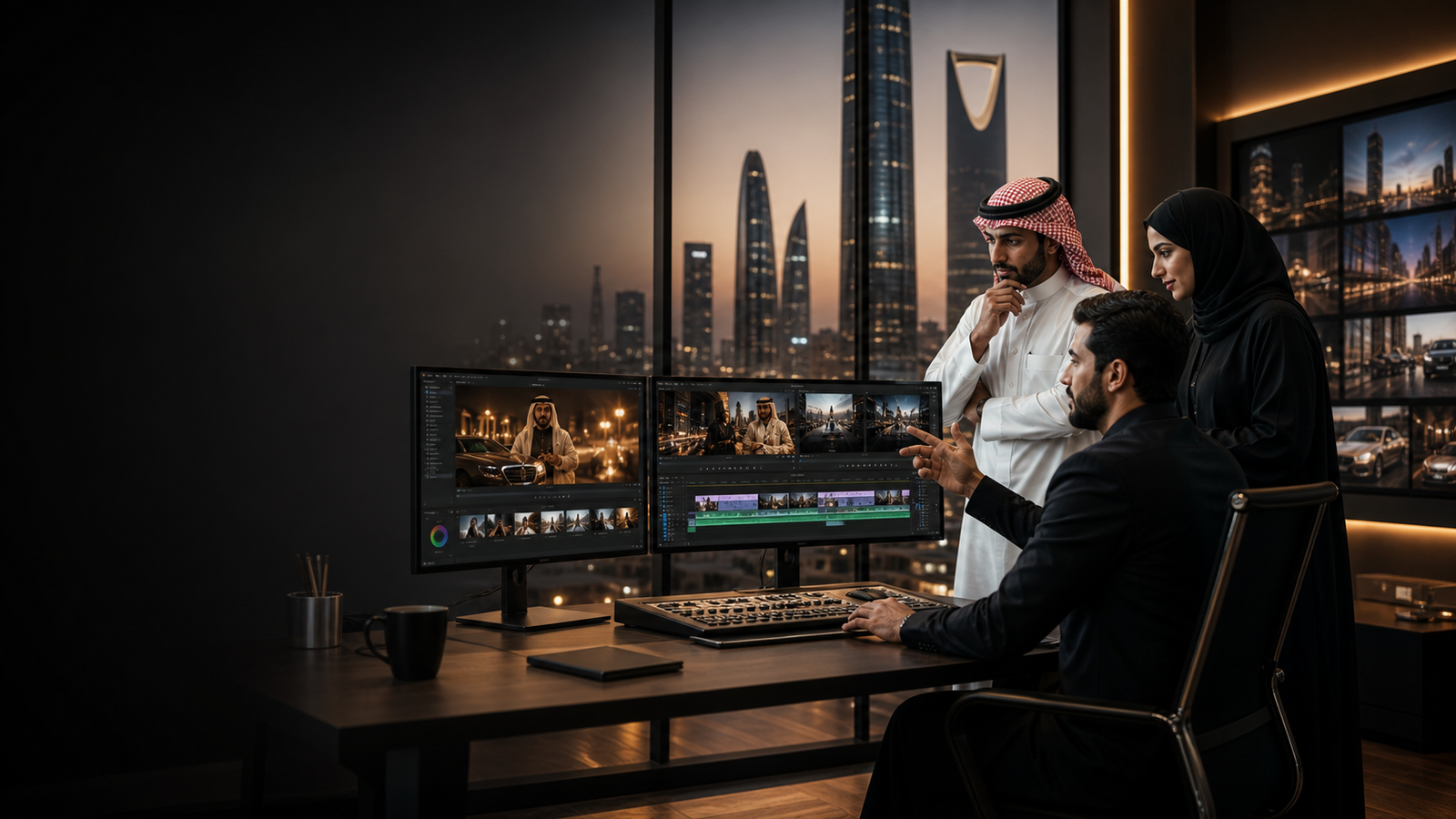
AI Video Editing has moved beyond automatic trimming and basic caption generation. Modern editing environments can search large footage libraries by visual meaning, build rough cuts from transcripts or scripts, translate captions, extend shots, improve dialogue, and generate new visual or audio material inside an editing workflow. Adobe, for example, now supports AI-powered media search and generative media workflows directly inside Premiere, while DaVinci Resolve has introduced AI-assisted script, subtitle, multicamera, and audio functions.
For GCC businesses producing reels, product videos, interviews, event coverage, paid ads, or bilingual campaigns, this changes the economics of production. Editors can spend less skilled time finding quotes, cleaning pauses, and preparing platform variations.
That is where AI solutions for GCC businesses become useful: not as a substitute for creative direction, but as an operational layer that reduces low-value editing work and gives creative teams more capacity.
The better 2026 question is not, “Can AI edit video?” It is, “Which decisions are safe to automate, and which ones shape how customers perceive the brand?”
A brand can automate silence removal, transcription, and aspect-ratio variants without surrendering creative control.
But when a system decides which reaction to hold, whether an Arabic phrase sounds natural, or whether a luxury product should feel restrained rather than energetic, automation enters territory that still needs judgment.
The best candidates for automated video editing are repeatable, measurable tasks with a clear correct outcome. These steps consume production hours but rarely justify senior creative attention.
Long interviews, conferences, and corporate shoots can create hours of raw footage. AI-powered search can index dialogue and visuals so editors locate product shots, reactions, scenes, or specific sentences without scrubbing every frame. Adobe’s media-intelligence workflow supports visual, transcript, and metadata search.
This is a strong use of automation because AI handles retrieval while the editor decides what belongs in the story.
Talking-head content contains false starts, repetition, dead air, and filler. AI can remove much of this in a first assembly, while a human editor restores the pauses, reactions, and imperfections that make the speaker feel credible.
AI can generate first-pass transcripts, subtitle timing, and translations quickly.
Final review still matters. Brand names, Saudi place names, Gulf dialects, industry terminology, and Arabic-English code-switching can expose errors that appear minor to software but obvious to viewers.
A campaign may need 16:9, 1:1, 4:5, and 9:16 versions. AI-assisted reframing can keep a face, product, or action inside the visible frame while creating these variations. Automate the adaptation, then check the result before publishing.
If a business needs consistent output at this scale, the stronger purchase is usually a workflow rather than a single tool. Well-designed professional video editing services can combine automation with quality control so the brand gains speed without pushing unfinished AI output directly into the market.
The value of AI-powered video editing becomes more obvious when a brand looks at the entire production chain rather than one isolated feature.
A conventional workflow moves through ingest, organization, transcription, selects, rough cuts, audio cleanup, captions, graphics, resizing, export, review, and revision. AI-assisted video editing can shorten several of those stages.
This avoids a common mistake: asking AI at the end to “make the video better.” It creates more value when it removes mechanical work before creative decisions begin.
For marketing teams, the same principle can connect production more closely with digital marketing for GCC businesses. Instead of creating one master video and thinking about distribution later, teams can plan short-form cuts, landing-page videos, remarketing assets, product clips, and campaign variants from the beginning.
Cheaper versioning lets brands test more hooks, lengths, openings, calls to action, and formats. The goal is not dozens of near-duplicates, but a controlled family of assets built from one strong concept.
Generative AI for video editing is most useful when it solves a specific production gap.
A shot may end too early. A transition may need two extra seconds. A clean product background may not have been captured. An unwanted object may appear in the frame. The team may need a simple insert, environmental variation, or sound effect that was not recorded on location.
Current generative tools increasingly address these gaps. Adobe’s Generative Extend can add a short amount of video or ambient audio to an existing clip, while newer timeline-based generative workflows can create video and sound effects within the editing environment. Runway’s current Edit Studio also supports prompt-based changes such as object removal, background replacement, product swaps, relighting, and visual transformations.
For most businesses, the highest-value generative use is not creating an entire campaign from synthetic footage.
It is rescuing production.
A hospitality brand can fix a distracting object in a room shot. An e-commerce team can create cleaner visual variations from approved footage. A corporate editor can extend ambient sound under a transition. A property campaign can adjust a background element instead of reopening an entire shoot.
Generated footage is not automatically on-brand, factually accurate, legally usable in every context, or visually consistent with the original production.
Human review remains mandatory when a generated element affects a real product, property, person, customer promise, location, cultural symbol, or material fact.
If AI changes production mechanics, automate aggressively.
If AI changes meaning, identity, representation, or a customer-facing claim, require human approval.
AI video editing for GCC brands operates inside a specific commercial and cultural environment.
The Gulf is not one uniform audience. When production value falters, as shown in our research on why Gulf businesses lose customers due to unprofessional videos, credibility is lost. A style that works for a retail promotion in Riyadh may feel wrong for premium real estate in Doha. A meme-driven edit may suit a youth restaurant brand but weaken a finance, healthcare, government, or B2B company.
That is why branding and creative services still matter even when editing software becomes more capable. The editor needs a brand system to edit against: typography, pacing, motion rules, music direction, logo behavior, visual hierarchy, product presentation, Arabic treatment, and an established definition of what the brand should feel like.
AI can imitate recurring patterns, but a brand does not become distinctive by averaging patterns.
Human creative direction decides whether a Saudi luxury brand should communicate through restraint, space, and texture; whether a logistics company should prioritize operational clarity; or whether a tourism campaign should lead with atmosphere, hospitality, landscape, or convenience.
That decision precedes editing.
As explored in our guide to Arabic-first video editing for Saudi audiences, Arabic video editing is one of the clearest areas where automation should assist rather than own the final output.
Machine transcription and translation can save time, particularly for first-pass subtitles and multilingual versioning. But Arabic introduces choices that are not purely grammatical.
Should the copy use Modern Standard Arabic or a local dialect? Should a Saudi campaign sound formal, conversational, youthful, premium, or corporate? To see how leading brands craft high-status visual identity, explore how video editing turns a normal business into a premium brand in the GCC. Is the sentence direct enough for a short caption? Does the subtitle preserve the speaker’s intent, or has translation flattened the personality?
Language also affects composition.
Arabic is right-to-left. Mixed Arabic and English lines can create spacing and hierarchy problems. Numbers, Latin brand names, punctuation, and product terminology may need manual adjustments. Animated captions need to remain readable without breaking words in awkward places or forcing the viewer to process too much text at once.
For brands investing in social media marketing in Saudi Arabia, this review is commercially important. A reel may have technically accurate subtitles and still feel foreign if its phrasing, rhythm, references, and visual treatment do not match how the intended audience communicates.
A Gulf audience can immediately sense when a supposedly local piece of content has been translated literally from English.
Arabic-speaking reviewers can adapt captions, shorten lines, protect tone, and decide when English terminology should remain.
AI can generate options. A person should choose the version the customer actually sees.
Automate the draft; approve the meaning.
The human video editor vs AI debate becomes simpler when editing is treated as decision-making rather than software operation.
AI is exceptionally useful when the desired output can be described through a rule.
Remove pauses. Find the clip containing the red car. Center the speaker. Generate captions. Clean background noise. Resize the sequence. Extend the shot. Remove an object.
Human editors become more valuable when the desired outcome is subjective.
Make the founder feel credible but not over-rehearsed. Build tension without making the video dramatic. Make the property feel premium without using luxury clichés. Keep the video energetic while preserving the seriousness of the service.
Those instructions contain judgment.
A strong editor understands what information to reveal first, what to delay, what to remove, and what the audience needs to feel before the call to action arrives.
That skill is difficult to reduce to a prompt because the correct choice depends on context.
A 0.8-second cut may feel fast in one sequence and slow in another. A pause can look like a mistake or create authority. A reaction shot can feel natural or manipulative depending on where it appears.
AI can optimize patterns. Editors shape experience.
Many weak business videos are not under-edited; they are over-edited.
Too many zooms, captions, sound effects, transitions, icons, stock clips, and animated elements compete with the message. A skilled editor knows when not to add something.
That restraint is especially important for enterprise, government, finance, healthcare, real estate, and premium GCC brands.
Performance advertising adds another layer to AI vs human video editing.
AI can produce alternate openings, resize creatives, create subtitle versions, clean product footage, and prepare multiple cuts for campaign testing. That makes it valuable for high-volume ad production.
But the winning ad still depends on the offer, audience awareness level, proof, objection handling, message hierarchy, and creative angle.
A machine can produce six visual variations of a weak proposition. It cannot rescue an offer the audience does not value.
For teams running PPC advertising in Saudi Arabia, the productive model is to use AI for iteration after the campaign concept is sound. Human marketers and editors decide the promise, proof, tone, first-frame idea, and CTA; automation accelerates controlled variants.
Test different hooks, opening frames, video lengths, caption treatments, product demonstrations, testimonials, and calls to action.
Keep the underlying claim consistent so performance data remains interpretable.
AI content creation for brands can create the illusion that source quality no longer matters.
It does.
The “materials” of modern video production are still the raw assets: camera footage, product shots, interviews, B-roll, voice recordings, logos, fonts, motion templates, brand guidelines, music licenses, captions, product data, scripts, screenshots, and customer proof.
AI works better when those inputs are structured and intentional.
Clean audio produces stronger transcripts. Consistent product angles improve visual continuity. Organized footage improves search. Approved brand assets reduce accidental inconsistency. Well-written scripts make automated selects more useful.
A business should therefore invest in asset quality even if more of its post-production becomes automated.
Use clear folder structures, sensible filenames, version control, approved logos, current product imagery, brand fonts, legal music sources, bilingual copy banks, and reusable motion systems.
This turns AI from a novelty into infrastructure.
AI video production works best when teams define exactly where automation stops.
Verify names, prices, features, locations, captions, translations, and any generated visual that could misrepresent reality.
Review typography, logo use, motion, music, pacing, voice, and overall finish.
Confirm that the edit fits the intended market, language, platform, and buying stage. This three-gate model keeps fast production from becoming careless production.
The future of video editing is orchestration, not a choice between manual production and one-click generation.
Editors will increasingly manage searchable libraries, AI-generated selects, transcript-driven assemblies, generative repair, automated versioning, captions, and quality-control checkpoints. Their value moves away from repetitive timeline labor and toward taste, narrative structure, supervision, and problem-solving.
When machines handle mechanical work, skilled editors can spend more time improving openings, tightening arguments, selecting proof, shaping emotion, and protecting brand quality. That is where competitive advantage remains.
Do not choose AI video editing tools by feature count. Start with the production bottleneck.
If your team loses hours finding clips, prioritize search and transcription. If short-form production is slow, prioritize rough-cut automation, captions, and reframing. If campaigns need many variants, build controlled versioning. If quality is inconsistent, strengthen creative direction before buying more software.
A small team may need one AI-assisted editor. An e-commerce brand may need templates, asset management, resizing, product variations, and approval controls. A corporate group may prioritize multilingual editing, governance, security, and stakeholder review.
The right stack depends on volume, risk, creative complexity, and the cost of getting a public-facing message wrong.
AI Video Editing is becoming part of normal post-production, not a separate experimental category. The brands that benefit most will not be the ones that automate everything. They will automate the work that does not require taste and protect the decisions that directly shape trust, emotion, and brand perception.
For GCC companies producing Arabic, English, paid, organic, corporate, social, and campaign content at scale, that hybrid model offers a practical advantage: faster turnaround, more usable variants, lower production friction, and stronger creative focus. If your team is ready to build that kind of workflow, Codhaus Agency can help you move from disconnected editing tasks to a more structured, AI-assisted video production system that still keeps experienced human judgment at the center of every customer-facing video.
Yes, when AI handles defined production tasks and a qualified person reviews the result. It is useful for transcription, footage discovery, rough assemblies, captioning, cleanup, reframing, object removal, shot extension, and versioning. Brand-sensitive work still needs human creative and language review.
AI can replace parts of an editor’s workload, especially repetitive technical tasks. It does not reliably replace strategic storytelling, pacing, visual taste, cultural judgment, brand interpretation, or final responsibility for what a video communicates.
The strongest use is workflow compression. Automate logging, transcription, first-pass trimming, captions, cleanup, footage search, resizing, and repetitive variants. Keep humans focused on concept, narrative, brand quality, and final approval.
Yes, but Arabic content should receive human review. Dialect, tone, right-to-left typography, mixed Arabic-English copy, subtitle length, brand terminology, and local phrasing can all affect whether the final video feels native to the audience.
Key risks include inaccurate captions, weak translations, generic pacing, inconsistent branding, misleading generated details, and publishing without adequate review. Clear approval gates reduce them.
Yes, particularly for ideation, variations, backgrounds, inserts, effects, and controlled testing. Review every generated element that could affect product representation, trust, cultural context, or a customer-facing claim.
Final brand approval, sensitive cultural decisions, Arabic nuance, high-stakes claims, testimonial integrity, regulated messaging, narrative strategy, and any edit that materially changes what a real person, product, property, or service appears to say or do should remain under human control.
Choose one recurring production problem first. Measure how much time it consumes, automate the most repetitive stage, define a human review point, and compare turnaround time and output quality. Expand only after the workflow proves reliable.
June 10, 2026
Read More
June 14, 2026
Read More
June 6, 2026
Read More
June 15, 2026
Read More
May 24, 2026
Read More