Mobile App Development in Saudi Arabia: Plan to Launch
Mobile app development in Saudi Arabia starts with decisions that a quotation alone cannot settle: who the product serves, which task it improves and what your business must operate after release. This guide explains how to turn those decisions into a defined first version, choose a suitable development approach and compare proposals against the same requirements. It also covers Arabic user experience, backend integrations, privacy planning and the work behind an app-store submission. Use it to prepare a brief that developers can estimate and your team can approve.
Start Your Mobile App Development Plan with the Business Problem
Identify the user and the task worth improving
Start with a sentence your operations team can challenge: “Our customers need to book an available appointment without waiting for someone to confirm it manually.” This identifies a user, an action and a current problem. “We need an app like our competitor’s” identifies none of them.
Speak to the people completing and supporting the task. Review how requests arrive, where information gets copied and which exceptions create follow-up calls. If staff repeatedly correct incomplete addresses, adding a booking screen without improving address capture will carry the same problem into a new channel.
Choose one primary user journey for the first release. A customer, branch manager and field worker may all interact with the product, but their priorities differ. Record what each person needs to see and what they may change.
Decide whether an app, a mobile website or both fit the need
A mobile website can be appropriate when visitors arrive occasionally through search, check information and submit a straightforward enquiry. An installed app becomes more compelling when users return regularly or need device features, carefully designed offline workflows or ongoing account access.
Test these requirements instead of treating installation as proof of value. Ask what customers gain by keeping the app on their phones. For an internal product, establish whether staff use company devices or their own: that decision affects support, access and distribution planning.
Define an outcome your business can measure
Set the outcome before approving features. For a booking product, completed bookings and avoidable support enquiries may be more useful than screen views. For a field-service product, the relevant outcome could be tasks submitted with the required evidence.
Record the present process where possible. Without a baseline, the team may struggle to explain whether the app improved anything. Define how the outcome will be measured and who reviews it after launch.
| Planning field | What the brief should establish |
|---|---|
| Primary user | The person whose task the first release must support |
| Core task | The action that user should complete successfully |
| Current difficulty | The delay, error or inconvenience being addressed |
| Business outcome | The observable improvement the business wants |
| Release boundary | What the first version deliberately leaves for later |
Define the First Release of Your Custom Mobile App Development Project
Map the complete journey, including the exceptions
Consider an illustrative appointment app. Selecting a service and choosing a time are only part of the journey. Someone must maintain availability, approve changes, answer questions and deal with cancellations. If those actions have no owner, the app can accept business that the company cannot reliably fulfil.
Map the customer journey alongside the administrative workflow. Show where information moves between people and systems. Identify what happens when a slot becomes unavailable, a payment remains pending or the customer loses connectivity before seeing confirmation.
This is where custom mobile app development earns its purpose: the product should reflect the business’s actual rules. Agree those rules before approving a design that silently assumes a different process.
Separate essential functionality from later improvements
A minimum viable product still needs a complete, usable core journey. Reducing scope might mean launching with one service category or one operating area. It should not mean accepting payments without a reliable way to identify successful transactions.
Separate customer essentials, operational essentials and optional improvements. A support team’s ability to find a booking can matter more at launch than a loyalty programme. Prioritise the work that lets the business deliver its promise.
| Illustrative feature | User or operational need | Release decision | Acceptance evidence |
|---|---|---|---|
| Appointment selection | Choose a genuinely available slot | First release | Conflicting reservations are handled correctly |
| Booking lookup | Help staff resolve customer enquiries | First release | Authorised staff can locate the correct record |
| Cancellation request | Handle an agreed business policy | First release if cancellations are offered | Status and availability update consistently |
| Loyalty rewards | Encourage repeat purchases | Later unless central to the product | Rules and customer value justify inclusion |
Write acceptance criteria a business owner can review
Turn “login works” into observable behaviour
For an OTP-based login, define expiry, retry behaviour and the message shown after an invalid entry. Agree what happens when delivery is delayed or a customer changes their phone number.
Review success and failure separately
A successful login demonstration does not establish that expired codes are rejected or that repeated attempts are controlled. Ask the team to demonstrate both situations against the agreed criteria.
Keep the approval evidence
Record the build reviewed, the result and any unresolved issue. That record gives your team a shared basis for acceptance and prevents the same behaviour being debated again at handover.
Plan the Saudi User Experience Before Finalising Screens
Decide how Arabic, English and RTL will work
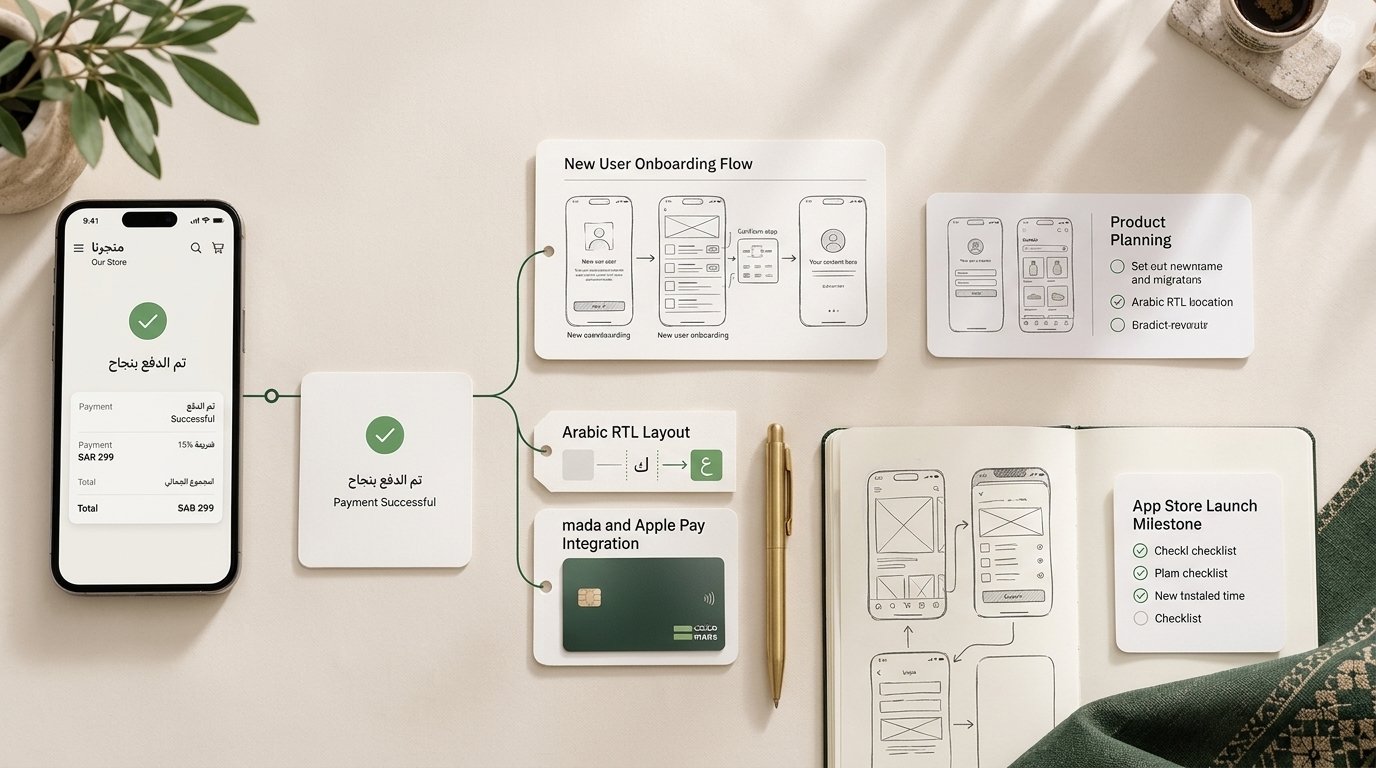
Establish language requirements from your intended users. If the app supports Arabic and English, budget for content preparation, layout review and testing in both. Translation is a product responsibility, not a last-minute replacement of labels.
Review mixed-direction content carefully. A screen may combine Arabic text, an email address, a booking reference and a phone number. Check that each remains readable and selectable. Review directional icons individually rather than mirroring every visual element automatically.
The same care applies to messages outside the app. A well-translated booking screen loses its usefulness when confirmation messages or cancellation instructions arrive in a language the customer does not understand.
Design local journeys around the business model
An app serving customers in Saudi Arabia may need local address handling, service-area checks or location selection. Define which information staff actually require to deliver the service. A map pin alone may not explain an entrance, while a long address form can ask for details the operation never uses.
For appointments, agree how times appear to customers and administrators, particularly when users or support staff operate across time zones. For purchases, show the payable amount and relevant terms before confirmation. Verify the requirements for the specific transaction model rather than copying another app’s checkout.
Test the prototype with representative users
Give participants a realistic task without explaining the interface first. Ask them to book, change or find something, then observe where they pause. Their behaviour provides better design evidence than asking whether they like the colour scheme.
| Review area | Practical check |
|---|---|
| Language switching | The current journey remains understandable after a switch |
| Mixed text | References, phone numbers and Arabic text display correctly |
| Forms | Labels, keyboards and validation support the expected input |
| Accessibility | Text remains usable at larger sizes and controls have clear labels |
| Confirmation | Users understand what happened and what to do next |
How to Choose the Right Mobile App Development Platform
Select iOS, Android or both from audience evidence
Use existing customer analytics, interviews or an internal device inventory to guide platform selection. A general national market-share figure cannot tell you which devices your particular customers use. If that evidence is missing, identify the uncertainty before committing the launch budget.
When commissioning iOS app development in Saudi Arabia, define the supported devices, essential Apple-specific capabilities and release responsibilities in the brief. Make the same decisions for every platform included in the project rather than treating the second platform as an automatic copy.
Launching on one platform can reduce the initial scope, but consider who it excludes. For an internal workforce using a known device fleet, the choice may be straightforward. A public-facing service may need broader access from the start.
When native mobile app development fits
Native development is worth evaluating when platform-specific interactions or device capabilities are central to the product. Ask the technical team to identify those requirements precisely. “Better performance” is too vague without a relevant task and a way to test it.
Separate platform implementations also create separate work to maintain and review. Establish how the team will keep business rules, features and release quality consistent across them.
When cross platform mobile app development makes sense
Sharing code can be useful when the product delivers broadly similar journeys on iOS and Android. However, shared development does not remove platform-specific behaviour or the need to test each release on its target devices.
React Native’s documentation explicitly supports separate platform-specific code where needed. That is a useful reminder when assessing promises of building everything once: ask which parts will be shared and which require dedicated implementation.Source: React Native platform-specific code.
Where hybrid mobile app development fits
In this comparison, hybrid means an application built primarily with web technologies inside a native container. It may suit web-oriented workflows, depending on the required device integrations and user experience. Evaluate it against the actual product rather than using “hybrid” as a label for every shared-code approach.
| Approach | Requirements to examine | Question to put to the supplier |
|---|---|---|
| Native | Platform-specific behaviour and demanding device integrations | Which requirement justifies separate implementations? |
| Cross-platform | Similar journeys across platforms with shared development | Where will platform-specific work remain? |
| Hybrid | Web-oriented functionality packaged for mobile distribution | Can the proposed approach demonstrate the required device behaviour? |
The best mobile app development platform is the one the team can justify against your audience, functionality and support obligations. Require a short written recommendation before approving the technical direction.
Compare Mobile App Development Frameworks Against Your Requirements
Evaluate mobile app development with Flutter
Flutter provides its own widget and rendering architecture and supports communication with platform-specific code through platform channels. Those capabilities explain why a framework assessment must consider both the interface and the native integrations behind it.Source: Flutter architectural overview.
When evaluating flutter development in Saudi Arabia, ask the supplier to demonstrate your difficult requirements early. A working sample of a required device integration tells you more than a polished demonstration of an unrelated app.
Review package maintenance, required operating-system support and the team’s ability to diagnose native issues. Establish who will handle upgrades after the initial delivery.
Evaluate React Native mobile app development
React Native offers core components and APIs for building mobile interfaces. Its component library is a starting point, while the requirements of your product determine the additional integrations and platform work.Source: React Native core components.
Existing React experience can inform the decision, but ask about mobile delivery experience as well. Device permissions, application lifecycle behaviour and store releases introduce responsibilities beyond a browser application.
Choose the best mobile app development framework for this project
Compare the proposed mobile app development technologies against the same brief. Ask what will be difficult, which dependencies matter, what must be prototyped and how another developer would maintain the code. Request explanations tied to your requirements rather than broad claims about popularity.
A small technical proof is particularly valuable when one uncertain feature could change the architecture. Approve that investigation before committing to the full build, and agree what result will establish feasibility.
Scope Mobile App Backend Development and Integrations Early
Identify the work behind the screens
The backend stores records, applies business rules and decides what users may access. The interface can show a price or available slot, but the system behind it must enforce the final decision consistently. Define which system owns each important piece of information.
For example, if an existing booking system controls availability, establish how the app reads and reserves it. Avoid creating a second, independent version of availability that staff must reconcile manually.
Map external dependencies before requesting a fixed estimate
Record every required integration, its purpose and its owner. Confirm whether documentation, test credentials and a suitable test environment exist. An integration cannot be estimated confidently from the name of a service alone.
| Integration field | What to confirm |
|---|---|
| Business purpose | The action or information the connection enables |
| System owner | Who can approve access and answer questions |
| Test access | Whether the team can verify behaviour before launch |
| Data authority | Which system holds the definitive record |
| Failure handling | How users and staff recover when the connection fails |
Define behaviour during delays and failures
Agree how the product handles a response that arrives late. If a customer taps “Pay” again after a timeout, the system should prevent unintended duplicate transactions. The correct behaviour depends on the payment integration and must be tested end to end.
Offline support needs equally specific rules. Decide what can be read or entered without connectivity, how changes synchronise and how conflicting edits are resolved. A generic promise that “the app works offline” leaves too much undecided.
If AI features are on the roadmap, define AI-ready mobile app architecture through concrete requirements: controlled data access, replaceable service integrations and a useful fallback when an external service fails. Do not buy an undefined architecture upgrade simply because it carries an AI label.
Build Privacy and Security Requirements into the Product Scope
Document the personal data each feature needs
Create a data inventory alongside the feature list. Record what is collected, why it is needed, who can access it and when it should be removed. Challenge permissions that do not support a clear user action.
Keep operational recommendations separate from legal conclusions. For Saudi requirements, use SDAIA’s current PDPL materials and implementing regulations to establish the obligations relevant to your organisation and processing activities. Assign someone qualified to resolve applicability before design decisions become expensive to change.Source: SDAIA laws and regulations.
Define access and recovery responsibilities
Agree which roles can view, change or export records. Enforce those permissions in the backend rather than relying only on hidden buttons. Test that one customer cannot access another customer’s information by changing a request.
Plan account recovery, administrator access and the handling of sensitive information in logs. Assign responsibility for responding to an incident and restoring service. These decisions belong in the delivery scope and operating procedures.
Review data transfers and third-party services
Saudi rules address transfers of personal data outside the Kingdom. Do not reduce that assessment to the location of the main database: review relevant service providers and data flows, and determine the applicable conditions and safeguards.Source: SDAIA personal data transfer regulation.
Treat store disclosures as a separate release responsibility. Google Play’s Data safety form requires developers to describe relevant collection, sharing and security practices. The person completing it needs an accurate understanding of the app and its integrated software.Source: Google Play Data safety.
Understand Mobile App Development Fees Before Comparing Quotes
Find the decisions that change the estimate
Screen counts are a weak substitute for scope. One checkout can require more work than several informational pages because it involves external systems, transaction states and recovery paths. User roles, integrations, languages, offline requirements and migration needs all affect the work to estimate.
When selecting a mobile app development company in Saudi Arabia, ask each shortlisted supplier to price the same documented release. Give them access to the same requirements and technical information so differences in proposals are easier to explain.
Separate the build from ongoing operation
A development fee does not necessarily include hosting, messaging, maps, payment processing or post-launch support. Request an explicit breakdown of setup charges, recurring subscriptions and usage-dependent costs. Establish which accounts the business must purchase directly.
| Cost category | Clarification to request |
|---|---|
| Discovery and design | Included outputs and revision boundaries |
| App and backend build | Platforms, roles, features and integrations covered |
| Testing and release | Devices, acceptance work and submission assistance |
| External services | Account owner, charging basis and estimated usage assumptions |
| Maintenance | Covered fixes, response arrangements and upgrade responsibilities |
| Future changes | Approval process and charging method |
There is no defensible project price without a defined scope. A broad public price range may help frame an initial conversation, but it cannot replace an estimate for your integrations, operating model and release requirements.
Read the mobile app development proposal alongside the contract
A proposal should explain the intended solution and deliverables. The mobile app development contract should make the commercial commitments clear, including acceptance, payment milestones, changes, intellectual-property arrangements and handover.
Clarify what happens if an external provider delays access or the business changes a requirement. Agree how the team distinguishes a defect from a new request. Resolve those questions before signing, while both parties can still price the responsibilities accurately.
Use Mobile App Development Stages as Review and Approval Points
Approve discovery and design through evidence
Discovery should produce a scope your business understands, including exclusions and dependencies. Design approval should establish that the proposed journeys support the agreed rules. Reviewing attractive screens without testing the workflow leaves important decisions unresolved.
Nominate one business decision-maker who can collect internal feedback and approve it. Conflicting instructions from different departments create rework even when each individual request seems reasonable.
Review working features during development
Ask for demonstrations against acceptance criteria. Check the administrator’s view as well as the customer’s screen, and confirm that connected systems receive the intended changes. Record issues with enough detail to reproduce them.
For android app development in Saudi Arabia, agree a representative test-device range based on your users and supported versions. Run comparable platform-appropriate checks across the other devices included in the release.
Keep business acceptance separate from technical completion
Test core journeys under realistic conditions: interrupted connectivity, invalid input, expired sessions and failed integrations. Review Arabic layouts, permissions and accessibility behaviour alongside functional testing. Prioritise failures that could prevent service delivery, expose information or create incorrect transactions.
| Stage | Evidence to review | Approval condition |
|---|---|---|
| Discovery | Requirements, scope and dependencies | Business rules and release boundaries are agreed |
| Design | Prototype and journey review | Intended users can understand the core tasks |
| Development | Working features and integration results | Implementation meets the agreed criteria |
| Acceptance | Business scenarios and defect records | Critical journeys pass and remaining issues are explicitly assessed |
| Release | Production checks and support readiness | Named owners approve launch readiness |
Tie milestone approval to the agreed evidence, not just a calendar date. If a critical journey fails, document the decision and remedy before treating the build as accepted. A clear review process protects the budget by finding misunderstandings while the team can still correct them within the planned work.
Prepare the App, Accounts and Operations for Launch
Confirm ownership before submission week
Your business should know who controls publishing accounts, source repositories, infrastructure and third-party subscriptions. Define access according to the agreement and maintain a record of account owners and recovery arrangements. Do not let release day become the first discussion about who can publish an update.
Handover also includes design assets, build instructions and operational documentation. Confirm that an authorised person can follow the process rather than receiving a folder whose contents nobody has checked.
Prepare store listings and reviewer access
Prepare accurate descriptions, screenshots, support information and privacy details. Apple’s review guidelines call for complete submissions and access to review the app’s functionality, including appropriate account access where needed. Google also asks developers to provide instructions for restricted areas.Sources: Apple App Review Guidelines,Google Play review preparation.
Account lifecycle requirements can affect the build itself. Apple states that apps supporting account creation must offer account deletion within the app. Plan that workflow early enough to implement its behaviour correctly.Source: Apple account deletion guidance.
Test production readiness beyond the store listing
Check live integrations, notification delivery, support access and monitoring in the release environment. A successful test against sandbox services does not establish that production credentials and configuration are correct.
| Launch decision | Evidence needed |
|---|---|
| Can customers complete the main task? | Successful end-to-end release-environment checks |
| Can staff fulfil and support requests? | Tested operational access and procedures |
| Are disclosures and listings accurate? | Review against actual release behaviour |
| Can the team detect a serious problem? | Working monitoring and assigned responders |
| Can the business recover? | Appropriate recovery procedures and verified backups where relevant |
Choose a controlled release where practical
Use a pilot or a supported staged-release mechanism when it suits the product. Define what would pause expansion, such as incorrect transactions or failures in the core journey. Store approval alone should not trigger broad promotion if the operation is not ready.
Plan recovery with mobile distribution in mind. Customers may retain older app versions, so an urgent fix cannot assume everyone updates immediately. Keep backend compatibility and support communication within the release plan.
Measure and Maintain the Product After Launch
Track completion of the task the app was built for
Measure the journey from entry to successful outcome. If many customers start a booking but few finish, examine the step where they leave and compare it with errors and support enquiries. Avoid deciding that every drop-off requires another feature.
For example, an unavailable appointment list may signal an operational capacity issue rather than a design problem. Combine product data with what the service team observes before funding a change.
Assign maintenance and prioritise the next release
Whether the product uses react native app development or another approach, assign responsibility for dependency updates, operating-system changes and regression testing. Define what the support agreement covers and how urgent incidents reach the right person.
Maintain a review record with the observed problem, supporting evidence, proposed response and owner. Fix reliability issues before expanding a journey that already frustrates users. New features should earn their place through business need, customer evidence or a clearly defined experiment.
Frequently Asked Questions About Mobile App Development in Saudi Arabia
It should define the primary user, core journey, business rules, first-release scope, platforms and integrations. Include language requirements, acceptance criteria and operational responsibilities. Identify unresolved decisions explicitly so suppliers can distinguish agreed work from assumptions that still need validation.
Choose from your audience’s devices, required capabilities and maintenance resources. An internal product for a known device fleet has different needs from a public service. Ask the supplier to justify its recommendation against your requirements and demonstrate any technically uncertain features before full development.
Evaluate native when platform-specific functionality strongly shapes the product. Consider shared development when the platforms deliver similar journeys, while budgeting for platform-specific work and testing. Compare the actual implementation and maintenance responsibilities rather than choosing from a claim that one approach is always faster or cheaper.
The main inputs include journey complexity, platforms, roles, backend work, integrations, language support and testing. Data migration and offline behaviour can add substantial scope. Request separate explanations of the build, third-party charges and ongoing maintenance so the initial quotation does not hide operating commitments.
Together, they should establish deliverables, exclusions, dependencies, acceptance, payment milestones, change control and support. Clarify ownership, repository access, publishing responsibilities and handover. The business should understand what it is purchasing and what additional work would require a separate approval.
The release needs functioning core journeys, verified production integrations, appropriate privacy and regulatory review, accurate store information and operational support. Assign owners to unresolved items. Allow for store review and possible corrections without promising an approval date the development team cannot control.
Turn the App Idea into an Approved Development Brief
A search for “mobile app development Saudi Arabia” can help you find suppliers, but a clear brief helps you choose between them. Define the user, approve the first-release journey and resolve the dependencies that could change the estimate. Then compare proposals on deliverables, responsibilities and evidence of readiness.
To discuss your project with Codhaus agency, share the app idea, intended users, required platforms and any existing systems it must connect to. Bring the uncertain parts as well as the confirmed requirements. That gives the conversation a practical starting point for defining scope and requesting a proposal that reflects the product you intend to launch.
Plan Your Mobile App with Codhaus
Turn your product vision into a structured development brief with verified native architecture, Arabic UX precision, and compliant Saudi payment integrations.
Schedule Architecture Discovery →